The word Purushārtha means Human Goals. In our spiritual texts, the word is also used in other senses—sometimes it refers to free will, and at other times to effort, endeavor, or deliberate choice. However, its primary meaning is the ultimate goals or destination of human life.
It is because of Purushārtha that human beings are considered superior to all other living beings. According to our śāstras, humans share similarities with animals and plants in many ways, such as āhāra (food), nidrā (sleep), bhaya (fear), and prānāyāma (progeny). But humans have an additional capacity: buddhi, the intellect or power of reasoning. This unique faculty makes us self-conscious, capable of self-judgment, reflection, and comparison.
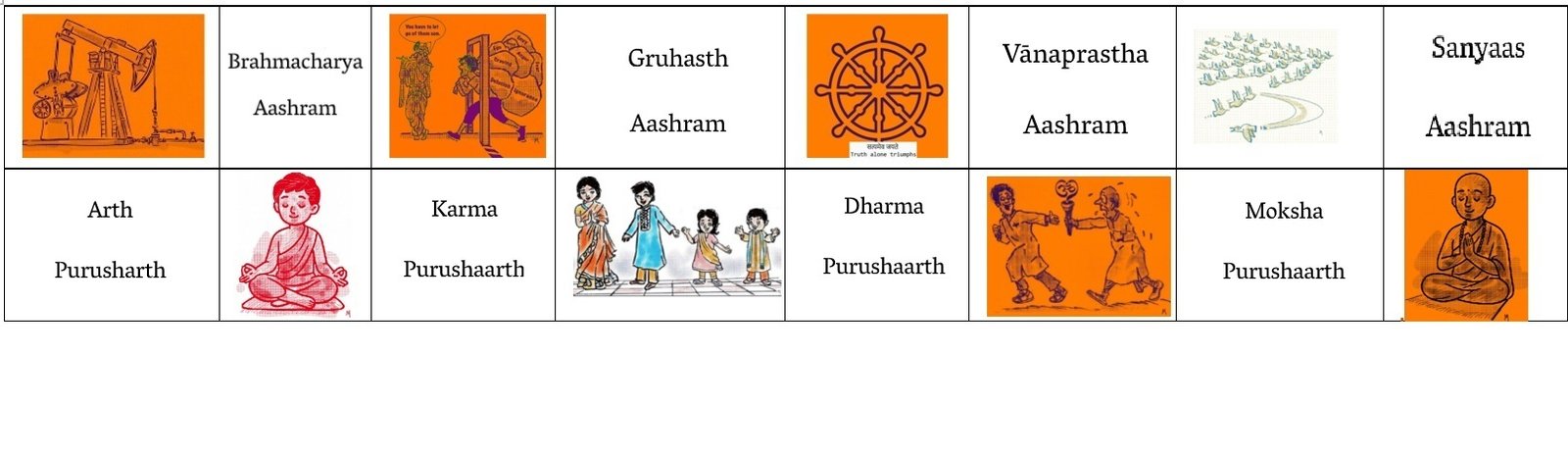
The number of human goals in pursuit of happiness is vast, but our śāstras classify them into four major categories that encompass all desires and pursuits. These are:
The word Āshram means a place or stage where one makes disciplined effort—whether for learning, service, self-growth, or spiritual practice. The Āshrama System in Hindu tradition is a four-stage framework that guides a person’s life from childhood to spiritual liberation. It helps individuals balance learning, duty, fulfillment, withdrawal, and spiritual pursuit in a natural, step-by-step progression.
The four Āshram are:
- Brahmacharya – Student life focused on study, discipline, and value-formation
- Grihastha – Householder life centered on family, work, and service.
- Vānaprastha – Withdrawal from household duties and a shift toward simplicity and social welfare.
- Sannyāsa – Renunciation and a life devoted fully to spiritual pursuits.
Our tradition views Purushārtha and Āshram as harmonious blueprints for balanced living, guiding a human being through the natural evolution of life:
Discipline →Responsibility → Withdrawal → Liberation
— Sanjay Mehta