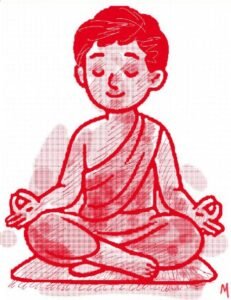
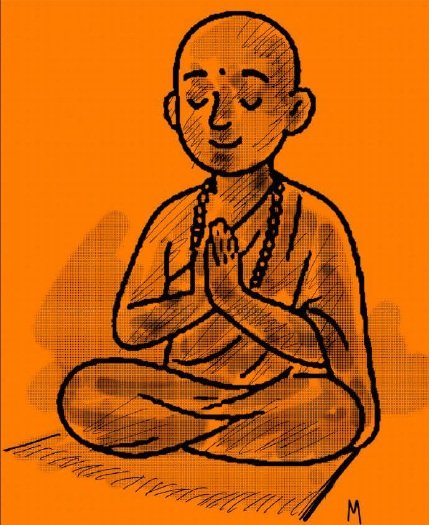
The word Āshram means a place or stage where one makes disciplined effort—whether for learning, service, self-growth, or spiritual practice. The Āshrama System in Hindu tradition is a four-stage framework that guides a person’s life from childhood to spiritual liberation. It helps individuals balance learning, duty, fulfillment, withdrawal, and spiritual pursuit in a natural, step-by-step progression.
Sanyās Āshram : Renunciation and a life devoted fully to spiritual pursuits.
Sanyāsa is the culmination of spiritual evolution. It is complete renunciation—not only of possessions and social identity, but also of desires, ego, and attachment. This is a jñāna-oriented ashram, the second stage of the nivṛtti mārga. It serves as the gateway to Self-realization.
In this final ashram, a person may live either at home or outside it; however, the essential transformation is internal. One learns to detach from the family and cultivate inner renunciation by recognizing that all associations in life inevitably end in separation or disconnection. One grows beyond all relationships and mentally hands over responsibilities to other family members. A sannyāsī dedicates most of their time to pursuing and spreading spiritual knowledge.
In Bhagvad Gitā, Shri Krishna defines a Sanyāsis:
ज्ञेयः सनित्यसंन्यासी यो न द्वेष्टि न काङ्ग्शाती ।
निर्द्वंद्वो हि महाबाहो सुखं बंधात्प्रमुच्यते ॥5.3॥
He should be known as a perpetual Sanyāsi who neither hates nor desires; is for free from pairs of opposites, O Arjun, he/she is easily set free from bondage.
This verse says that a true sanyāsi is the one who has gone beyond perception of contrast, which means he has transcended the inner instrument of mind and intellect. Most people must go through stages of karma yoga to reach this stage.
न द्वेष्ट्यकुशलं कर्म कुशले नानुषज्जते ।
त्यागी सत्त्वसमाविष्टो मेधावी छिन्नसंशयः ॥18.10॥
Those who neither avoid disagreeable work nor seek work because it is agreeable are people of true renunciation. They are pervaded by purity and intelligence (with the quality of the mode of goodness) and have no doubts (about the nature of work).
Summary
A person who progresses through all four stages of life nourishes both personal growth and societal welfare. Whether or not one physically enters each āshram, one must inwardly and mentally pass through all four stages. This vyavasthā (system) is designed for the systematic evolution of human beings so they may become jīvanmukta—free from the bondage of desires—here and now.
Depending on an individual’s mental temperament, all stages may not be necessary for everyone. However, for most people, this is the natural and beneficial path.
— Sanjay Mehta
Back to Purushārtha and Āshram Vyavasthā (System) – in Hindu Philosophy