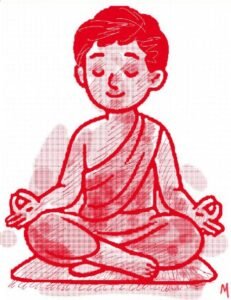

Nachiketa was a very inquisitive little boy. One day, his father performed a grand yajna, in which he invited several priests and gifted cows and bulls to them. Nachiketa was not happy to note that the animals being donated by his father, were old and useless. He thought, “My father will gift me to one of these priests. At least, the priest who receives me will not criticize my father for giving a useless gift.” He went to his father and said, “Father, who will you give me as a gift to?” The father got terribly angry and said, “I will gift you to Yama, the Devata of Death.” And the words came true. Nachiketa died immediately and his aatman arrived at the doorstep of the palace of Yama.
Unfortunately, Yama was away then. Nachiketa waited for three days, till Yama finally arrived. Seeing the little boy, hungry and thirsty, Yama felt sorry and offered three wishes to Nachiketa.
As a first boon, Nachiketa asked for the well-being of his father – free of anger and anxiety and with a calm mind, peacefulness, happiness, and his return to the mortal world alive.
As a second boon, he asked about the truth about yagna that leads one to live free from fear of death or old age, bondage of hunger and sorrow.
As the third boon, Nachiketa asked Yama about what happens to aatman after the death, and the knowledge that can lead one to a great life.
Yama explained to Nachiketa the following in response to third boon.
- Essence of all sentient beings is Brahman or pure consciousness.
- We are not body, mind, or intellect.
- Om is the symbol of both sagun, sakar as well as nirgun nirakar Brahman.
- We are wired to look outward for happiness, even though happiness is within, and therefore we should become introverted.
- The human body is like a chariot, roads are the sense objects, horses are senses, reins are mind, and intellect is the charioteer. We need to learn to control our senses through our intellect to live a meaningful life.
After becoming enlightened, Nachiketa returned to the mortal world with his father and his family.
— Sanjay Mehta